
Board game
Congkak
Congkak (also known as Sungka and Chongka among others), is a multi-lap sowing game likely derived from Mancala in the 15th century. Most Congkak or Sungka boards have seven pits on each of two sides, with a storehouse on each…
- Players
- 2
- Duration
- 15 min
- Age
- 6 and up
- Complexity
- —

Add to my shelf Sign in to add it to your shelf
Videos to learn
No rules video for this game yet. Know one?
Three ways to move forward anyway:
More artwork
In brief
Congkak (also known as Sungka and Chongka among others), is a multi-lap sowing game likely derived from Mancala in the 15th century.
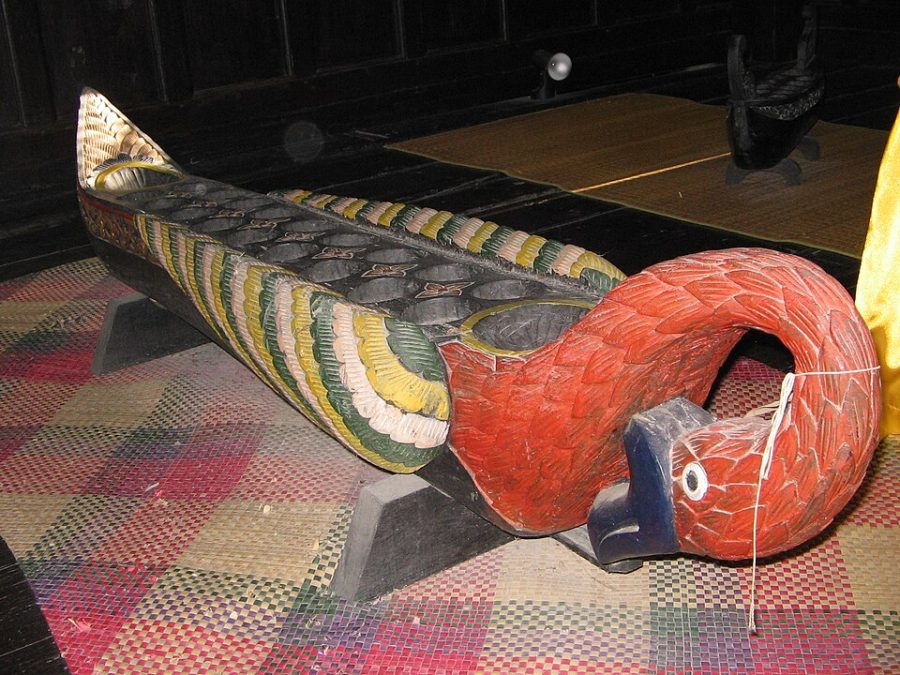
Most Congkak or Sungka boards have seven pits on each of two sides, with a storehouse on each end of the board for each player. However, some boards have more or less pits. Each side of the board belongs to one player. Boards are usually made of wood and carved into different designs. The seeds are cowrie shells, though other items can be used.
The game is played similar to Mancala with some notable differences. The goal of the game is to obtain the most seeds. The game starts off with seven seeds in each pit. Players get seeds by placing seeds into their storehouse. Players take the first turn simultaneously. During a player's turn, a player picks up pieces on their side of the board and drops a seed in each pit clockwise, placing a seed in their storehouse, but skipping the opponent's storehouse. If a player drops the final seed in a pit with seeds, the player picks up the seeds in the pit and continues their turn, distributing the picked up seeds in another lap. If a player drops the final seed in an empty pit on their side of the board, they capture all the seeds in the corresponding pit on the opponent's side of the board (as well as the seed they placed in an empty pit). A player's turn ends when a seed lands in an empty pit regardless of which side it lands. Play proceeds until all the seeds on one side of the board are empty. If there are still seeds on a side of the board, the player who owns the side gets all those sides.
Games can also be played in rounds. At the end of a round, each player fills up each pit on their side with the seeds they had in their storehouse; each pit gets seven seeds as in setup. Leftover seeds remain in their storehouse. If there are not enough seeds to fill a pit, the pit gets burned and removed from play. Players cannot put seeds into the burned pit. The series of rounds can be finished when a player can no longer sufficiently fill one pit with seven seeds.
Contribute to this page
Add a resource, correct information or report a link. Every contribution is gathered here and reviewed before publication.
Suggest a videoReviewed before publication
An account is needed to suggest a change. Create an account
Correct the detailsReviewed before publication
An account is needed to suggest a change. Create an account
Suggest a correctionReviewed before publication
An account is needed to suggest a change. Create an account
Suggest rules or a player aidReviewed before publication
An account is needed to suggest a change. Create an account
In the same spirit
Games that share its mechanics. Neither expansions nor other editions.


