
Board game · 2007
Tribune: Primus Inter Pares
In ancient Rome, tribunes were highly esteemed individuals elected by the people to represent them politically and militarily. In the board game Tribune: Primus Inter Pares, players take on the role of a powerful and ambitious…
- Players
- 2 to 5
- Duration
- 60 min
- Age
- 12 and up
- Complexity
- Family
Karl-Heinz Schmiel · Edge Entertainment

Add to my shelf Sign in to add it to your shelf
Videos to learn
All
Does this video explain the rules well? Vote with the arrows.
-

The video plays right here — it never leaves Rules of Play.
-
The video plays right here — it never leaves Rules of Play.
-

The video plays right here — it never leaves Rules of Play.
-

The video plays right here — it never leaves Rules of Play.
In brief
In ancient Rome, tribunes were highly esteemed individuals elected by the people to represent them politically and militarily. In the board game Tribune: Primus Inter Pares, players take on the role of a powerful and ambitious patrician family. By applying influences and manipulating controls over the various factions, they attempt to pave their way to victory in order to attain the high office of the tribune.
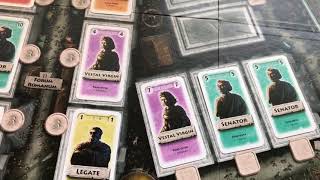
From the mind of the highly acclaimed designer of Die Macher, Karl-Heinz Schmiel, the gameplay in Tribune is a combination of worker placement and set collection. Each round, the players take turns by positioning their followers on the board to garner cards, achieve objectives, and/or attempt to take over factions. In order to gain control of a faction and to utilize its benefits, one must play a set of cards from that specific group. That person will remain in command of the faction until someone else stages a successful take-over by having another set that is either of higher quantity or higher sum of values.
Victory is achieved when a player has met the required number of objectives as specified on the victory condition card selected at the start of the game, which is dependent on the number of participants. Alternatively, you can choose to forego the use of a condition card and play with the point-value option. In this variant, the game ends when someone has collected a certain number of the faction markers, and the winner is the one with the highest scores as determined by the points assigned to each achievement.
Contribute to this page
Add a resource, correct information or report a link. Every contribution is gathered here and reviewed before publication.
Suggest a videoReviewed before publication
An account is needed to suggest a change. Create an account
Correct the detailsReviewed before publication
An account is needed to suggest a change. Create an account
Suggest a correctionReviewed before publication
An account is needed to suggest a change. Create an account
Suggest rules or a player aidReviewed before publication
An account is needed to suggest a change. Create an account
A video is broken or doesn't match the right game?No account required
In the same spirit
Games that share its mechanics. Neither expansions nor other editions.


