
Board game · 2003
Ubongo
In Ubongo, players compete to solve individual puzzles as quickly as they can to get first crack at the gems on hand for the taking. Original edition: The game board consists of six rows, with twelve gems (of various colors) pl…
- Players
- 1 to 4
- Duration
- 25 min
- Age
- 8 and up
- Complexity
- Beginner

Add to my shelf Sign in to add it to your shelf
Start here
 Recommended videoLa vidéorègle du jeu "Ubongo" par Yahndrev (#490)Full rules · 10 min 57Videoregles. Net
Your first game
The three moments to know before you start. Each step opens the video at the right spot.
Videos to learn
Quick summary1
View all videosAll
Does this video explain the rules well? Vote with the arrows.
-
The video plays right here — it never leaves Rules of Play.
The Track 11 stepsShow the 11 chapters
-

The video plays right here — it never leaves Rules of Play.
Type a word from the rule. Esc to close. · 11 chapters, across 1 video
-
La vidéorègle du jeu "Ubongo" par Yahndrev (#490)
Intro
00:00 Watch this clip
-
La vidéorègle du jeu "Ubongo" par Yahndrev (#490)
Présentation
00:13 Watch this clip
-
La vidéorègle du jeu "Ubongo" par Yahndrev (#490)
Matériel et Mise en Place
00:26 Watch this clip
-
La vidéorègle du jeu "Ubongo" par Yahndrev (#490)
But du Jeu
02:11 Watch this clip
-
La vidéorègle du jeu "Ubongo" par Yahndrev (#490)
Déroulement
02:41 Watch this clip
-
La vidéorègle du jeu "Ubongo" par Yahndrev (#490)
Gains de Pierres Précieuses
04:15 Watch this clip
-
La vidéorègle du jeu "Ubongo" par Yahndrev (#490)
Exemple de Manche en Mode Simple
05:43 Watch this clip
-
La vidéorègle du jeu "Ubongo" par Yahndrev (#490)
Cas Particuliers
06:55 Watch this clip
-
La vidéorègle du jeu "Ubongo" par Yahndrev (#490)
Fin de Partie
07:43 Watch this clip
-
La vidéorègle du jeu "Ubongo" par Yahndrev (#490)
Mode Avancé
08:25 Watch this clip
-
La vidéorègle du jeu "Ubongo" par Yahndrev (#490)
Conclusion
09:18 Watch this clip
No chapter carries that word
Chapters come from the headings of the videos, not from the rulebook text. Try another word, or:
Rules and documents
Documents are provided by their source. Check the edition and language before playing.
Rules
More artwork
In brief
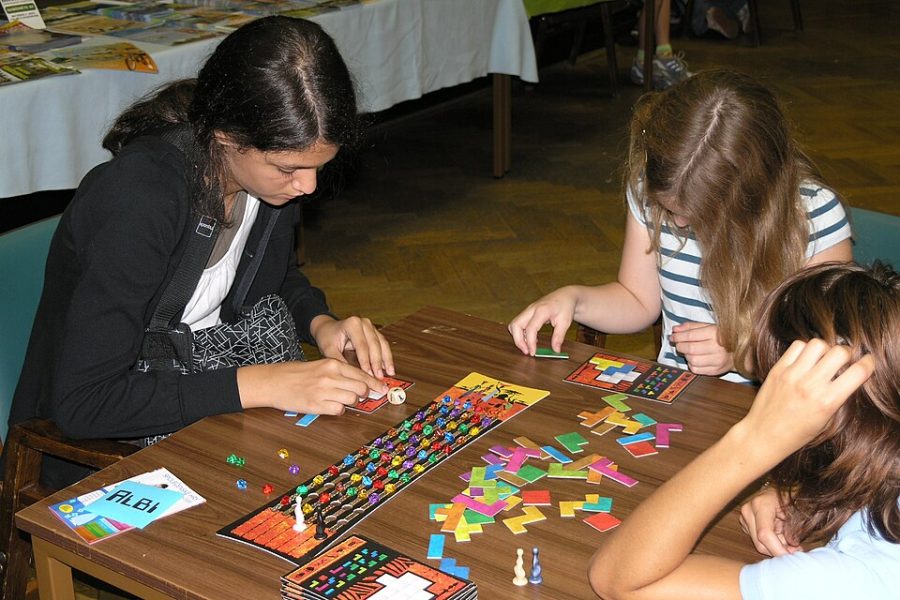
In Ubongo, players compete to solve individual puzzles as quickly as they can to get first crack at the gems on hand for the taking.
Original edition: The game board consists of six rows, with twelve gems (of various colors) placed in these rows. At the start of play, each player places their pawn in front of one of those rows. Each player also takes twelve polyominoes — that is, pieces consisting of 2-5 squares in some configuration; players use these pieces each round to try to recreate shapes.
At the start of a round, each player receives a puzzle card that depicts a shape created by some number of squares; one side of this card depicts six rows of 3 pieces, the other side depicts six rows of 4 pieces, for a more difficult puzzle. When everyone is ready, someone rolls a die to determine which row of pieces each player can use to recreate the shape on their individual card. The race is timed by a sand timer, and the outcome of this race determines the action on the main playing board.
Whoever first solves their puzzle in time gets to move their pawn up to three rows left or right, with the second player to finish moving two rows and the third player only one row. Players then collect two gems from the front of the row where their pawn is located, which means that the more rows you can move, the more control you have over which color gems you can collect. After collecting gems, each player receives a new puzzle card, and a new round begins.
After nine rounds, the game ends and whoever has collected the most gems in a single color wins! If players tie, then those players compare who has the most gems in a second color, and so on.
2015 edition: The puzzle-part of the game remains the same, but the scoring track and system has been greatly changed, to be the same as in Ubongo Extreme. There are no pawns anymore, but instead the winner takes a 3-point gem plus a random gem, the second-place player takes a 1-point gem plus a random gem, and others who finish within time take just a random gem. Whoever scores the most gem-points after nine rounds wins the game.
Contribute to this page
Add a resource, correct information or report a link. Every contribution is gathered here and reviewed before publication.
Suggest a videoReviewed before publication
An account is needed to suggest a change. Create an account
Correct the detailsReviewed before publication
An account is needed to suggest a change. Create an account
Suggest a correctionReviewed before publication
An account is needed to suggest a change. Create an account
Suggest rules or a player aidReviewed before publication
An account is needed to suggest a change. Create an account
A video is broken or doesn't match the right game?No account required
Report rules or a documentNo account required
In the same spirit
Games that share its mechanics. Neither expansions nor other editions.


